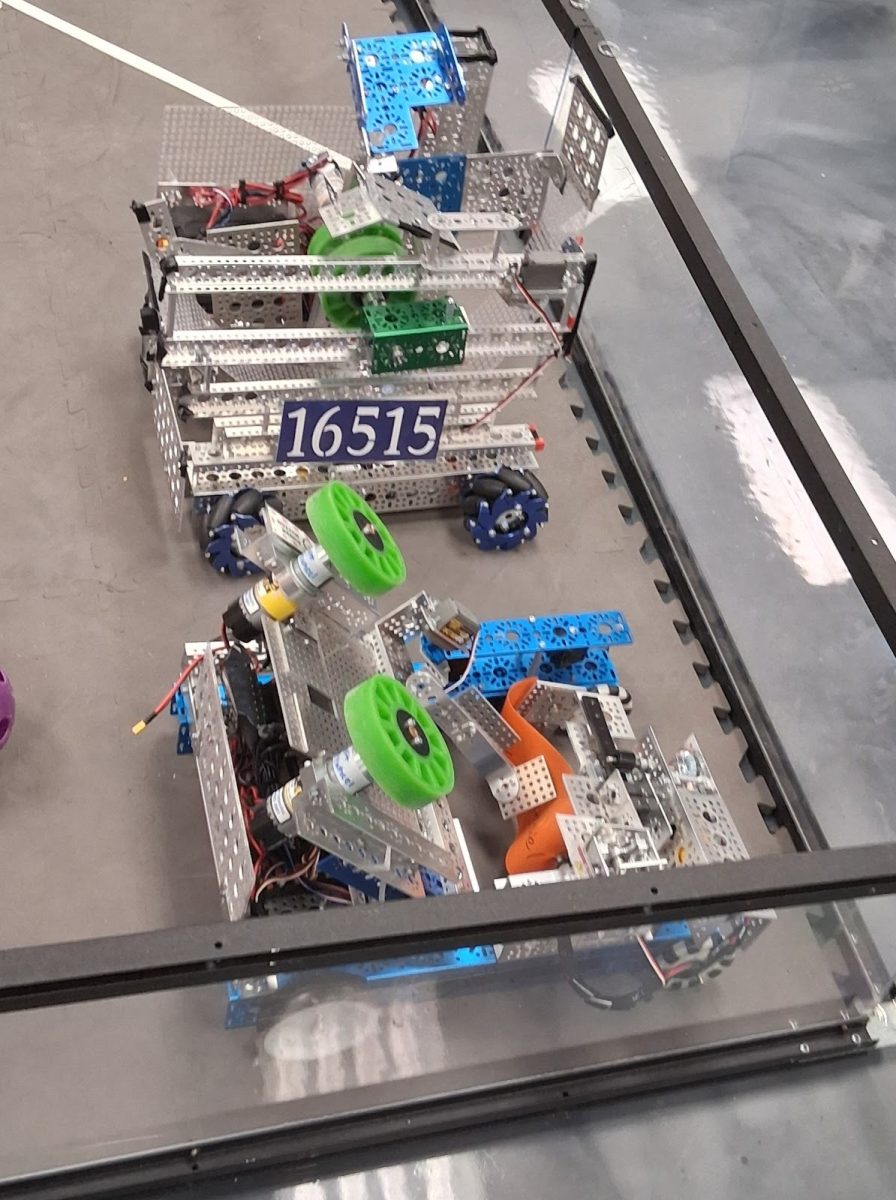
Robot. For some, the word spells the end of humanity, but for the Greenwood Robotics team, it spells a season full of ups, downs, and the occasional wheel falling off. As the season comes to an end, the team takes time to look back on all that has happened, and when one looks back into the robotics season, one sees various degrees of chaos. From the start of the season at SCK launch, to the end at State, the two robots designed by the team (16515 and 24280) have changed dramatically in both design and structure. What were these changes? What was the mild chaos that occurred near the beginning? And what changed between first draft and final product?
The easiest way to answer these questions is to start at the very beginning. There had already been several changes before the team’s first major event, a showcase at the SCK launch, but this was the first real test for the team. A chance to show off their skills. Well… supposedly.
One member of the robotics team, Eli Hutchinson, a senior, described the SCK launch as a “giant mess.” The 16515 robot had screws flying off the entire event, while the 24280 robot was dysfunctional in every way except the flywheel. That being said, Hutchison noted that he did not see any injuries throughout the event.
The beginning of the season was riddled with chaos, but it obviously did not end that way. What changed? The answer is simple: the engineering process. Camden Loftis, a sophomore who worked on the 16515 robot, described starting with a starter bot (one of the robotics competition’s basic design ideas) and adjusting over and over until everything was at its best. When asked for a specific engineering process, Loftis claimed it was “a lot of this thing doesn’t work the best, let’s just slap on another part and make it work.” As simple as it sounds, that is engineering in a nutshell, seeing what does not work and finding a solution that will make it work. The process can be seen again in the process for the 24280 robot, where team members Ragava Karpakambikaa and Ahaziah Ligon (both freshmen) noted that the initial design was inspired by hotwheels and ballista. “During the kickoff event, me and one of my friends were planning a design for the robot, when I was like ‘oh, you remember those old hotwheels toys? Or, like, the ones that boost you up into the loop?’” Karpakambikaa goes on to say that this was where the angled design of the robot came from. Ligon meanwhile notes that the design of the launching mechanism came from the ballista, explaining that “having a trigger you have to pull that pushes the ball forward to shoot it” and having a “natural arch angle” were features from the medieval weapon.
The robots were chaotic in the beginning of the year, but by the end, they made it all the way to state. Students were very satisfied with the end results, with Loftis claiming 16515 was a “respectable robot” who did “really well,” and Karpakambikaa and Ligon claiming 24280 was “excellent” and their “greatest invention.” The team’s coach, Mrs. Hillary Galloway, said the team gained a lot in way of organization, code, and mechanisms, specifically citing the addition of a 16515 autonomous and 24280’s clever claw mechanism (the latter of which can be seen in the article photo). The team is already looking forward to next season, brainstorming ways to go even further in the 2026-2027 season and beyond.